Someone Is Placing a Massive Bet on PayPal
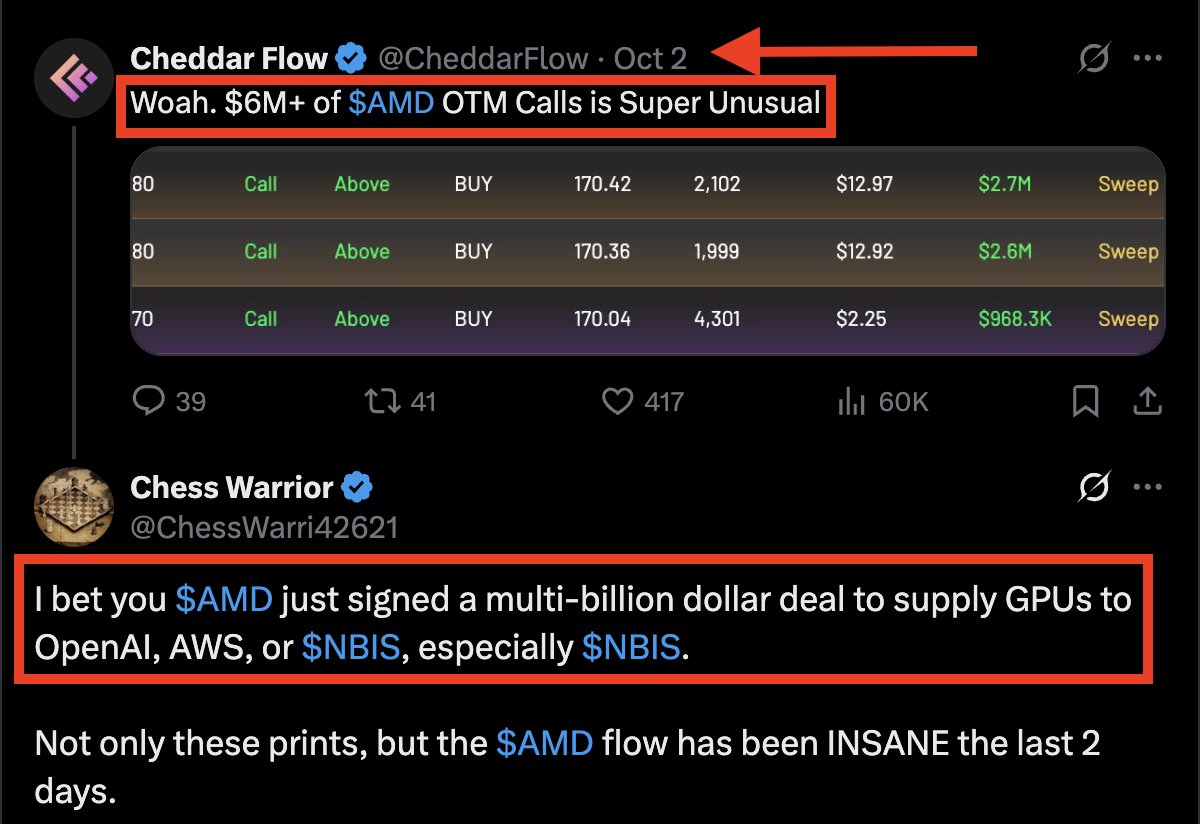
Something is brewing at PayPal. The options market is showing the kind of aggressive activity that often precedes a material event. This pattern is worth a closer look, especially given recent precedents. A few days ago, a similar story unfolded with AMD. Traders on X flagged unusual call options volume just days before the company announced a major GPU partnership with OpenAI. The event served as a clear reminder that someone, somewhere always knows something that the rest of us don’t.
Over the last couple of days, those same whispers started around PayPal. And the stock keeps climbing and climbing. So what's going on? Is this just random noise? Or is a major catalyst about to drop? Let's dig in. Our FrameworkWe will use a three-step framework to analyze the situation and figure out what’s really going on.
If this was forwarded to you, join the list to receive future AI investing insights directly.
Part 1: Find the SmokeFirst, let's check the tape. We need to confirm the chatter is backed by real money. We are analyzing three key metrics: total options volume relative to its average, the change in open interest, and the ratio of calls to puts. Let's use the AI assistant mode within Perplexity Comet, our agentic browser. And yes, the browser is doing the clicking, not me. Prompt: You are on Unusual Whales and conducting an analysis for PayPal ($PYPL). For the last 3 trading days, extract the total options volume, 30-day average volume, total call volume, total put volume, and total open interest. Present the data in a table and calculate the Volume/Avg Volume Ratio and the Call/Put Ratio for each day. Then, provide a short synthesis of the data, concluding with a verdict on whether the activity is anomalous. The result: The data confirms the activity is anomalous. On October 7th, total options volume reached nearly five times its 30-day average. The call-to-put ratio of 6.6-to-1 indicates strong directional speculation. This level of one-sided call buying, combined with a steady increase in open interest, suggests new, convicted capital is entering the market. The smoke is real. Part 2: Find the FireSo the smoke is real. But what specific bets are being made, and by whom? We need to analyze the specific characteristics of the trades to determine if this is institutional positioning. 2a. Analyze the Options Flow We are looking for the footprints of institutional capital. This means focusing on trade size, the specific contracts being targeted, and the urgency of execution. Prompt: Analyze PayPal's options flow for the most recent 3 days. Cluster the activity and identify where the conviction lies. Specifically, determine: - Key Strikes & Expirations: Which 2-3 strike prices and expiration dates saw the most significant volume and open interest increases?- - - Trade Size: What was the premium of the 10 largest trades? Were they institutional size (>$100k)? - Trade Type & Aggression: For the largest trades, what was the execution type (e.g., sweep, block, cross)? What percentage were executed on the ask, signaling maximum urgency? Synthesize these findings into a brief summary of the market's bet. The institutional footprints are obvious. The bets are clustered on short-dated calls expiring October 10th. The $72, $75, and $80 strikes are lit up with millions in premium ($PYPL closed at $74.61 on October 7). This suggests a bet on a significant, near-term price movement. And the size confirms it. All ten of the largest trades were six- and seven-figures. This is smart money positioning for something big. 2b. Check the Dark Pools Remember AMD? Dark pool volumes were hot. The ultimate confirmation of institutional conviction. What about PayPal? Prompt: Compare dark pool activity for PayPal ($PYPL) and AMD ($AMD) over the past 30 days. Filter for trades with a premium over $10 million. For both tickers, list the dates and sizes of any qualifying trades. Provide a concluding sentence on whether PayPal's recent dark pool activity shows a similar level of institutional conviction as AMD's did prior to its news. Here, the analysis presents a more nuanced picture. PayPal's dark pool feed is notably more subdued than AMD's was. While there is a consistent flow of trades in the $15M to $33M range (except one outlier), we are not seeing the nine-figure prints that signaled massive institutional accumulation in AMD. This could imply one of two things: the conviction is being expressed primarily through the leverage of the options market, or the institutions involved are taking greater care to disguise their activity this time. The fire is hot, but contained. Part 3: Connecting the CatalystWe have the what. A massive, one-sided bet from institutional players. Now for the why. Let's connect the dots. We'll use Grok (enable expert mode) so that we can leverage X's live feed of tweets. Prompt: Act as a hedge fund analyst explaining the unusual bullish options activity in PayPal ($PYPL). Your task is to identify the single most probable hidden catalyst by exploring PayPal's recent confirmed news from the last few weeks (from official filings and press releases) alongside persistent market rumors from X and blogs. Focus specifically on AI-related initiatives and partnerships or anything else timely that can move the needle, especially events brewing for expected announcements this month. Then put 2 and 2 together to piece together any evidence, considering other companies' recent brewing events for context to have an informed conjecture as to what is the unannounced event that the options market is baking in.
There are so many things that could be causing this; remember, $PYPL is a $70B market cap company and there could be a lot of muddying variables. Nonetheless the options activity seems to point that the market is positioning for a more significant event. Connecting the dots, one theory centers on OpenAI. Think about it. OpenAI is on a partnership binge, not only for more compute (both NVIDIA and AMD), but also on the consumer side; this week they just announced their “apps within ChatGPT” initiative, and that includes deals with Shopify and Etsy for commerce in ChatGPT. Both Etsy and Shopify are commerce platforms with their own branded payments (ShopPay & Etsy Payments). But under the hood they use different payment processors. Most notably, Stripe and PayPal. PayPal already has a major partnership with Perplexity AI, embedding its payment tools directly into the chat interface for shopping and subscriptions. I can't guarantee that this will happen, and we can be wrong even if the logic checks out, but the AI seems to point at the possibility of a partnership between OpenAI and PayPal to power the payments infrastructure behind the agentic shopping experience. The Bottom LineSo, what's the bottom line? The market is betting on a near-term catalyst. And AI is hinting at a partnership with OpenAI. Someone, somewhere always knows something that the rest of us don’t. Our job is to listen. Bonus: Find the Next TradeWant to find the next one? The first step is spotting the chatter before it hits the mainstream. Here's a prompt I use with Grok to scan Twitter in real time. Prompt: Scan X for tweets in the last 24 hours that mention phrases like "unusual options activity," "huge call buying," or "options flow" alongside a stock ticker. Filter for tweets with high engagement and list the top 10 most mentioned tickers. |

Enjoyed this article?
Get more AI for finance content delivered to your inbox.